
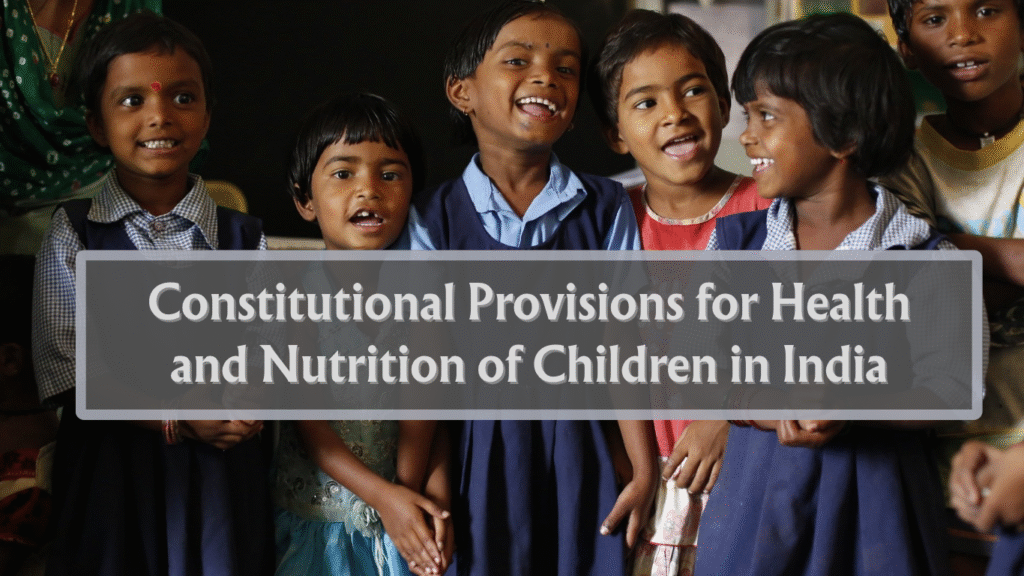
Constitutional Provisions for Health and Nutrition of Children in India-The health and nutrition of children are foundational to the progress of any nation. A healthy child is more likely to grow into a productive and responsible citizen, contributing meaningfully to society. Recognizing the importance of children’s welfare, Constitution Law in India has incorporated several provisions to safeguard the physical and mental well-being of children. These provisions are not only enshrined in the form of Fundamental Rights and Directive Principles of State Policy (DPSPs) but also supported by numerous laws and schemes aimed at fulfilling these constitutional promises.
Constitutional Framework for Children’s Health and Nutrition
One of the most significant developments in child rights in India has been the incorporation of Article 21A in the Constitution, which ensures the Right to Education. However, children cannot benefit from education unless they are healthy and adequately nourished. Hence, multiple constitutional provisions complement this right by addressing their health and nutritional needs.
Article 21 – Right to Life
The Right to Life under Article 21 has been expansively interpreted by the judiciary to include the right to live with dignity. This implicitly encompasses the right to health and nutrition. The Supreme Court of India, through various judgments, has held that the right to health is an integral part of the right to life. It has directed governments to implement schemes like mid-day meals in schools to improve nutrition and encourage school attendance.
Article 39(e) and 39(f) – Directive Principles of State Policy
These provisions urge the state to ensure that children are not forced to enter vocations unsuited to their age or strength and that childhood and youth are protected against exploitation and moral and material abandonment. Ensuring proper nutrition and health is central to these goals.
Article 47 – Duty of the State to Raise the Level of Nutrition and Public Health
Article 47 explicitly directs the State to raise the level of nutrition and improve public health as a primary duty. While this article is part of the DPSPs and is not justiciable, it sets a guiding principle for the formulation of public policies. The Integrated Child Development Services (ICDS) scheme and the Mid-Day Meal Scheme are practical implementations of this directive.
Article 45 – Early Childhood Care and Education
Though primarily about education, Article 45 mandates that the State shall endeavor to provide early childhood care and education for all children until they complete the age of six years. Health and nutrition are integral components of early childhood care.
Judicial Interventions Strengthening Child Health Rights
Indian courts have played a pivotal role in reinforcing constitutional mandates. In the landmark case of People’s Union for Civil Liberties v. Union of India (2001), the Supreme Court directed that cooked mid-day meals be provided in all government and government-aided primary schools. This ruling strengthened the right to food and nutrition for children under constitutional guarantees.
In various other cases, courts have reprimanded state governments for inadequate healthcare facilities and directed improvements in maternal and child healthcare infrastructure.
Government Schemes and Legal Support
In addition to constitutional provisions, the government has initiated various schemes to translate these principles into action. The ICDS, launched in 1975, provides food, preschool education, and primary healthcare to children under six years and their mothers. It remains one of the largest and most successful programs in the world.
Other schemes include:
-
National Health Mission (NHM)
-
Rashtriya Bal Swasthya Karyakram (RBSK)
-
Poshan Abhiyan (National Nutrition Mission)
These programs are designed to meet the broader goals outlined in Constitution Law concerning public health and nutrition.
Challenges in Implementation
Despite the existence of strong constitutional provisions and welfare schemes, challenges remain. Malnutrition, anemia, and preventable diseases still affect a large section of children, especially in rural and underprivileged areas. Lack of awareness, inadequate infrastructure, and poor implementation of government schemes continue to hinder progress.
Conclusion
The child rights in India are well-protected under the Constitution, especially concerning health and nutrition. However, the gap between legal provisions and on-ground realities must be addressed through better governance, awareness, and accountability. As rightly pointed out by Advocate P.S. Khurana, “The Constitution has done its part by ensuring the framework; it is now the responsibility of society and state machinery to translate those rights into reality for every child.”
By strengthening implementation mechanisms and fostering community participation, India can move closer to the vision enshrined in its Constitution—a nation where every child is healthy, nourished, and empowered.