
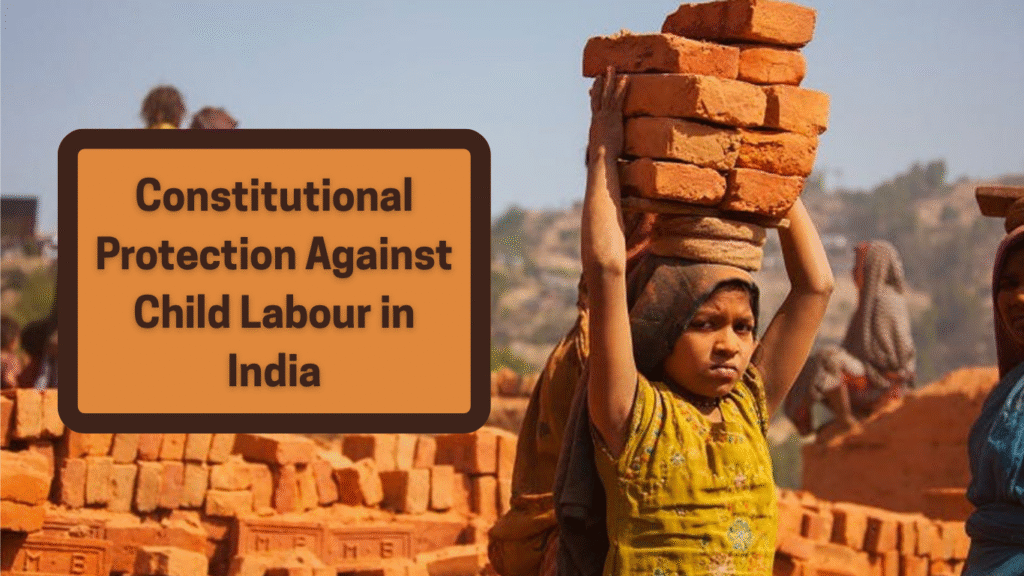
Constitutional Protection Against Child Labour in India
Constitutional Protection Against Child Labour in India – Child labour remains one of the most pressing human rights issues in India, despite a strong legal and constitutional framework in place. Every child has the right to a childhood free from exploitation, yet many are forced into labour due to poverty, lack of education, and socio-economic inequality. The Constitution of India, being the supreme law of the land, provides robust safeguards for the protection and welfare of children. This blog explores the constitutional provisions that prohibit child labour and how the legal system in India upholds children’s rights.
Understanding Child Labour in India
Child labour is defined as the employment of children below the age of 14 in any work that deprives them of their childhood, interferes with their education, and is mentally, physically, socially, or morally dangerous. According to the 2011 Census, over 10 million children in India were engaged in labour activities. These alarming figures reflect the urgent need to enforce and expand existing legal measures.
Constitutional Provisions Against Child Labour
The Indian Constitution has several articles that directly or indirectly address the issue of child labour and aim to protect children’s rights to education, health, and dignity. These include:
Article 24 – Prohibition of Employment of Children
This article clearly states:
“No child below the age of 14 years shall be employed to work in any factory or mine or engaged in any other hazardous employment.”
Article 24 is a fundamental right, and its inclusion in Part III of the Constitution reflects the country’s commitment to protect its children from exploitation and hazardous conditions.
Article 21A – Right to Education
This article guarantees:
“The State shall provide free and compulsory education to all children of the age of six to fourteen years.”
This provision ensures that instead of being pushed into labour, children must be in schools. The Right to Education Act, 2009 operationalizes this constitutional guarantee and acts as a preventive measure against child labour.
Article 39(e) and 39(f) – Directive Principles of State Policy
These directives guide the State to:
-
Ensure that children are not abused and that they are not forced by economic necessity to enter vocations unsuited to their age or strength.
-
Provide children with opportunities to develop in a healthy manner and in conditions of freedom and dignity.
Though not enforceable in courts like fundamental rights, these principles underline the Constitution law objective of creating a just and equitable society for all citizens, especially the most vulnerable.
Legislative Measures Supporting the Constitution
To strengthen these constitutional protections, the Indian Parliament has enacted several laws:
-
The Child Labour (Prohibition and Regulation) Act, 1986: Prohibits employment of children below 14 in certain occupations and regulates working conditions in others.
-
The Child and Adolescent Labour (Prohibition and Regulation) Amendment Act, 2016: Bans all forms of employment for children under 14, while allowing adolescents (14–18) to work in non-hazardous occupations.
-
The Right of Children to Free and Compulsory Education Act, 2009: Enforces Article 21A by ensuring access to free education.
These laws complement Constitution law protections and serve as crucial instruments for ensuring child welfare and preventing exploitation.
Role of Judiciary and NGOs
The Indian judiciary has been proactive in protecting children from forced labour. In several landmark cases, courts have directed governments to rescue, rehabilitate, and reintegrate child labourers into mainstream society. NGOs also play a significant role in identifying victims and spreading awareness about child rights and constitutional protections.
Challenges in Implementation
Despite constitutional safeguards, enforcement remains a major challenge due to:
-
Lack of awareness among poor families
-
Inadequate infrastructure to support free education
-
Loopholes in legislation and poor monitoring
Corruption, social apathy, and economic compulsions continue to push children into labour, especially in unorganized sectors and rural regions.
Conclusion
The Indian Constitution lays down a strong foundation for the protection of children from labour and exploitation. Articles 24, 21A, and 39 clearly emphasize the State’s obligation towards ensuring a safe and healthy environment for children. However, laws and policies will remain ineffective without strict enforcement, public awareness, and collective responsibility.
Advocate P.S. Khurana, a legal expert in child rights and labour law, stresses that “True change will come only when constitutional values are embraced not just by the government but by every citizen.” By educating communities and empowering children, we can uphold the spirit of the Constitution and end child labour in India.