
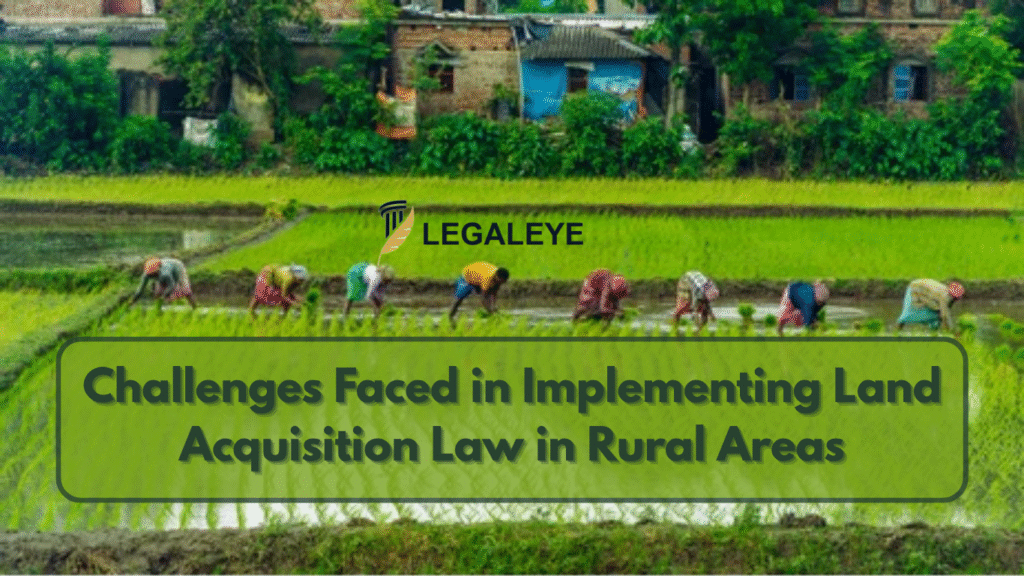
Challenges Faced in Implementing Land Acquisition Law in Rural Areas
Challenges Faced in Implementing Land Acquisition Law in Rural Areas-Land acquisition has always been one of the most sensitive and debated issues in India, especially in rural areas where the majority of the population depends on agriculture for their livelihood. The Land Acquisition Law was introduced to ensure fair compensation, transparency, and rehabilitation for landowners whose land is acquired for infrastructure, industrial, or public projects. While the law brought several reforms compared to earlier legislation, its implementation in rural regions still faces numerous challenges. These challenges stem from social, economic, administrative, and cultural factors that often slow down projects and create disputes between the government, private developers, and local communities.
1. Lack of Awareness and Legal Literacy
One of the biggest hurdles in implementing land acquisition processes in rural areas is the lack of awareness among landowners. Most rural populations are not fully aware of their rights under the Land Acquisition Law and depend heavily on intermediaries for information. This often leads to misunderstandings, misinformation, and even exploitation. Farmers and villagers sometimes agree to unfavorable terms simply because they are not aware of compensation mechanisms, rehabilitation packages, or legal remedies available to them.
2. Emotional Attachment to Land
In rural India, land is not just an economic asset but also a source of identity, tradition, and social standing. Generations of families cultivate the same land, making it emotionally priceless. For many farmers, losing their land means losing a way of life, not just a livelihood. This emotional attachment often creates resistance to land acquisition, even when compensation is offered. Convincing such communities requires more than just financial packages; it requires cultural sensitivity and trust-building measures.
3. Delays in Compensation and Rehabilitation
Timely and fair compensation is critical for smooth land acquisition. However, delays in compensation payments are common due to bureaucratic red tape, disputes over land records, and corruption. Even when compensation is awarded, the rehabilitation and resettlement measures are often poorly implemented. For instance, displaced families may be relocated to areas without proper facilities, affecting their quality of life and livelihood opportunities. This not only creates dissatisfaction but also sparks protests and legal battles.
4. Inaccurate Land Records
Another major challenge is the poor state of land records in rural India. Many land parcels lack updated ownership details, clear demarcation, or proper documentation. Multiple claims on the same piece of land are frequent, leading to disputes during the acquisition process. Without transparent and digitized land records, authorities find it difficult to establish rightful ownership, further complicating the process and delaying development projects.
5. Resistance from Farmers’ Groups and NGOs
Farmers’ unions and social activists play an active role in land acquisition disputes. While their efforts often protect villagers from exploitation, strong opposition movements sometimes delay essential infrastructure projects like highways, railways, and power plants. Balancing development goals with farmers’ interests becomes a challenge for policymakers, especially when protests gain political momentum.
6. Political Interference
Land acquisition in rural areas is often influenced by local and regional politics. Politicians may exploit land-related issues to gain support, sometimes fueling resistance even when the acquisition is legally justified. Political interference not only slows down the process but also undermines the credibility of government efforts, making it difficult to reach consensus with affected communities.
7. Livelihood Concerns
Even with compensation, rural families often struggle to adapt after losing agricultural land. Cash compensation may not provide long-term financial stability, particularly for small farmers who lack alternative skills or employment opportunities. Without proper rehabilitation policies that focus on skill development, job creation, and sustainable livelihood alternatives, displaced farmers face economic insecurity and social marginalization.
8. Environmental and Social Impact Assessments
The law mandates social and environmental impact assessments before land can be acquired. However, in many rural cases, these assessments are either rushed or poorly executed. As a result, villagers lose trust in the process, believing that their concerns about displacement, pollution, or cultural disruption are ignored. Lack of transparency in these assessments further intensifies resistance.
Conclusion
The implementation of land acquisition in rural areas is far more complex than in urban regions. It is not merely a legal or financial process but also a deeply social, cultural, and emotional matter. Addressing challenges such as lack of awareness, poor land records, livelihood concerns, and political interference requires a balanced approach that combines fair legal mechanisms with sensitivity towards local communities. Strengthening legal literacy, digitizing land records, ensuring timely compensation, and involving local bodies in decision-making can go a long way in reducing conflicts. Ultimately, successful implementation of land acquisition requires trust, transparency, and a genuine commitment to balancing development with the rights of rural citizens.
Legal Advisor: Advocate P.S. Khurana