
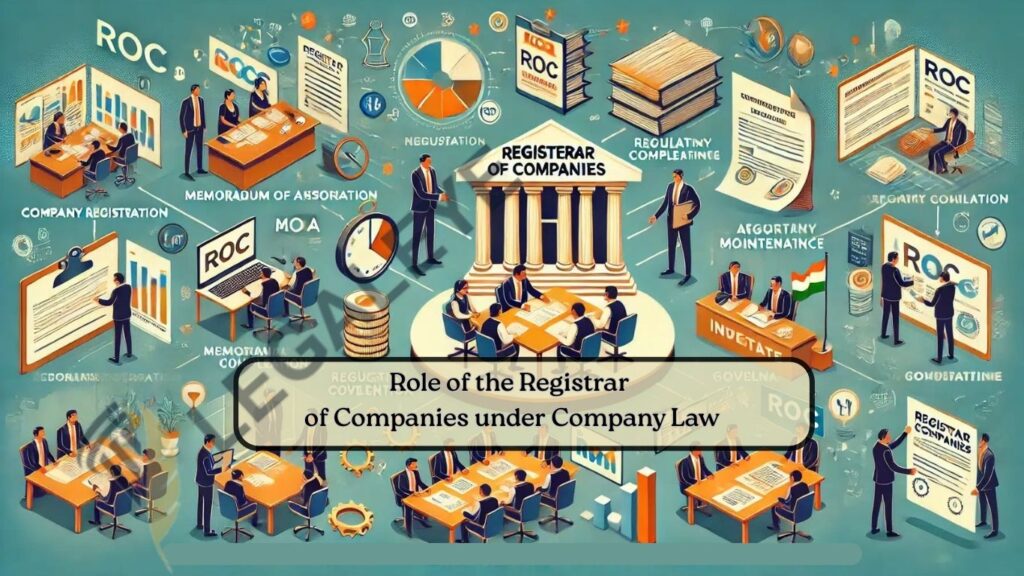
Role of the Registrar of Companies under Company Law
Role of the Registrar of Companies under Company Law—The Registrar of Companies (ROC) plays a pivotal role in regulating and supervising companies operating in India. Appointed under the Ministry of Corporate Affairs (MCA), the ROC ensures that companies comply with statutory requirements laid down under the Companies Act, 2013. The office of the Registrar of Companies acts as a watchdog, maintaining transparency, accountability, and legal discipline in corporate governance. Understanding the role of the ROC is essential for business owners, directors, and stakeholders to ensure smooth and lawful operations.
Legal Authority of the Registrar of Companies
The Registrar of Companies derives its powers from Company Law, primarily governed by the Companies Act, 2013. Each state and union territory in India has an ROC office that administers company registrations and compliance within its jurisdiction. The ROC has the authority to register companies, collect statutory filings, and take action against non-compliant entities.
The legal framework empowers the ROC to inspect documents, issue notices, impose penalties, and even initiate prosecution for violations. This ensures that companies operate within the boundaries of the law and adhere to corporate ethics.
Incorporation and Registration of Companies
One of the primary responsibilities of the Registrar of Companies is the incorporation of companies. When promoters submit incorporation documents such as the Memorandum of Association (MOA), Articles of Association (AOA), and statutory declarations, the ROC examines them for legal correctness. Upon satisfaction, the ROC issues a Certificate of Incorporation, which acts as conclusive proof of a company’s legal existence.
Without approval from the ROC, a company cannot legally commence business. This makes the ROC the first and most important regulatory authority a company interacts with during its lifecycle.
Maintenance of Company Records
The ROC maintains a central repository of company records, including financial statements, annual returns, charge documents, and details of directors and shareholders. These records are made available to the public through the MCA portal, promoting transparency and informed decision-making.
By maintaining updated and accurate records, the ROC ensures corporate accountability and protects the interests of investors, creditors, and the general public.
Monitoring Statutory Compliance
Ensuring compliance is one of the most crucial functions of the ROC. Companies are required to file annual returns, balance sheets, and various event-based forms within prescribed timelines. The Registrar monitors these filings and flags delays or non-compliance.
According to Advocate P.S. Khurana, a legal expert in corporate and commercial laws, timely compliance with ROC requirements not only avoids penalties but also enhances a company’s credibility in the market. Non-compliance can lead to heavy fines, director disqualification, or even company strike-off.
Power to Conduct Inspections and Inquiries
The Registrar of Companies has the authority to conduct inspections, inquiries, and investigations into a company’s affairs. If there is suspicion of fraud, mismanagement, or violation of statutory provisions, the ROC may call for explanations, inspect books of accounts, and refer matters for further investigation.
These powers act as a deterrent against corporate misconduct and ensure adherence to Company Law principles.
Action Against Defaulting Companies
The ROC has the power to initiate legal action against companies that fail to comply with statutory obligations. This includes issuing show-cause notices, levying penalties, striking off dormant companies, and recommending prosecution where necessary.
In recent years, the ROC has taken strict action against shell companies and non-operational entities to clean up the corporate registry and prevent financial irregularities.
Role in Corporate Governance
The Registrar of Companies plays a vital role in strengthening corporate governance by ensuring disclosure norms and compliance standards are met. By enforcing statutory filings and monitoring company conduct, the ROC promotes ethical business practices and investor confidence.
Advocate P.S. Khurana emphasizes that robust regulatory oversight by the ROC is essential for maintaining trust in the corporate ecosystem, especially in an era of increasing digital and cross-border business operations.
Conclusion
The Registrar of Companies serves as the backbone of corporate regulation in India. From incorporation and compliance monitoring to enforcement and public transparency, the ROC ensures that companies function within the legal framework. Its role is indispensable in maintaining corporate discipline, protecting stakeholders, and upholding the integrity of the corporate sector. For businesses aiming for sustainable growth, understanding and respecting the authority of the ROC is not just a legal requirement but a strategic necessity.