
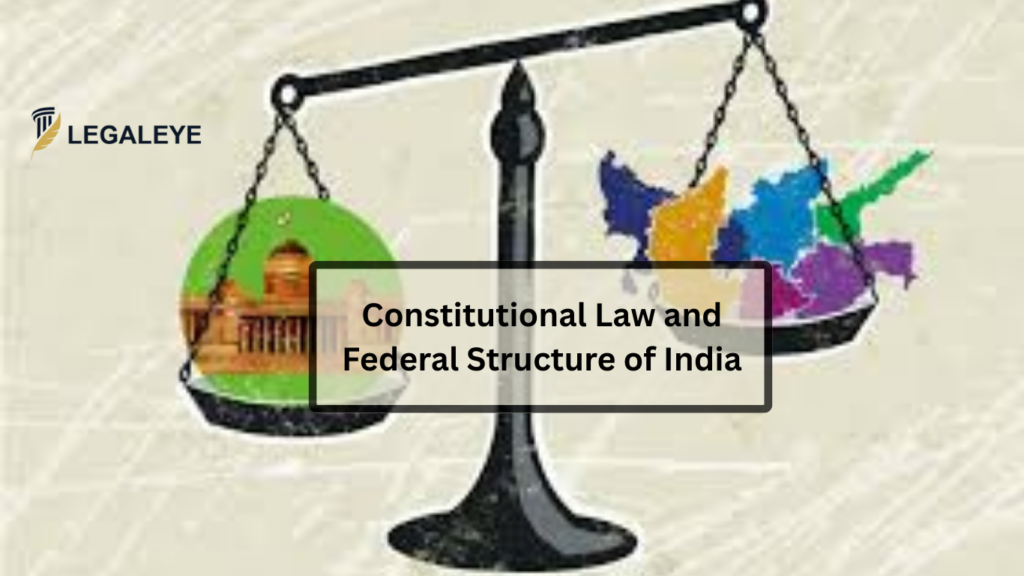
Constitutional Law and Federal Structure of India
Constitutional Law and Federal Structure of India-The federal structure of India is one of the most distinctive features of its Constitution. Unlike rigid federal systems seen in some countries, India follows a unique model that balances unity with regional autonomy. This balance is achieved and regulated through Constitutional Law, which defines the distribution of powers between the Centre and the States while ensuring the supremacy of the Constitution.
Understanding Federalism in India
Federalism refers to a system of governance where power is divided between a central authority and constituent political units, such as states or provinces. In India, this division is not merely political but constitutional. The Indian Constitution clearly demarcates the legislative, executive, and financial powers of the Union and the States, ensuring that neither oversteps its authority without constitutional backing.
India is often described as a “quasi-federal” state because, while it has federal features, it also possesses strong unitary elements. This flexible nature allows the Centre to assume greater powers during emergencies or situations that threaten national integrity.
Constitutional Basis of the Federal Structure
The federal framework of India is primarily laid down in Articles 245 to 293 of the Constitution. These provisions outline the extent of legislative powers of Parliament and State Legislatures. The Seventh Schedule plays a crucial role by dividing subjects into three lists:
-
Union List – Subjects of national importance such as defence, foreign affairs, and currency
-
State List – Subjects of local or regional importance like police, public health, and agriculture
-
Concurrent List – Subjects where both the Centre and States can legislate, such as education and criminal law
This distribution ensures clarity while allowing cooperative governance. However, in case of conflict between Union and State laws on concurrent subjects, the Union law generally prevails, reinforcing constitutional supremacy.
Role of the Judiciary in Maintaining Federal Balance
The judiciary, particularly the Supreme Court of India, acts as the guardian of the Constitution and plays a vital role in maintaining the federal balance. Through judicial review, courts interpret constitutional provisions and resolve disputes between the Centre and the States.
Landmark judgments such as State of West Bengal v. Union of India and S.R. Bommai v. Union of India have strengthened federal principles by limiting arbitrary use of central power and safeguarding state autonomy. These rulings highlight how Constitutional Law functions as a protective shield against misuse of authority.
Centre–State Relations and Cooperative Federalism
Modern Indian governance increasingly emphasizes cooperative federalism, where the Centre and States work collaboratively rather than competitively. Institutions like the Inter-State Council, Finance Commission, and GST Council reflect this cooperative approach.
Fiscal federalism also plays a significant role, as financial resources are shared through constitutional mechanisms. While the Centre collects major taxes, states receive their share based on recommendations of the Finance Commission, ensuring equitable development across regions.
Emergency Provisions and Their Impact
One of the strongest unitary features of the Indian federal system lies in its emergency provisions. During national, state, or financial emergencies, the Centre can assume enhanced powers, including control over state functions. While these provisions are essential for safeguarding national unity, they must be exercised with caution to prevent erosion of federal principles.
Judicial scrutiny has evolved over time to ensure that emergency powers are not misused, reinforcing constitutional morality and accountability.
Challenges to India’s Federal Structure
Despite its robust design, India’s federal system faces several challenges. Issues such as misuse of Governor’s powers, disputes over resource allocation, and tensions over legislative competence continue to test Centre–State relations. Rapid economic changes and evolving political dynamics also demand continuous interpretation and adaptation of Constitutional Law to meet contemporary needs.
Conclusion
India’s federal structure is a carefully crafted constitutional arrangement that balances unity with diversity. It allows the nation to function as a single entity while respecting regional identities and aspirations. The success of this system lies in strict adherence to constitutional principles, judicial vigilance, and cooperative governance.
A sound understanding of constitutional provisions and federal principles is essential for legal professionals, policymakers, and citizens alike. As emphasized by Advocate P.S. Khurana, constitutional awareness is the foundation of a strong democracy and an effective federal system.