
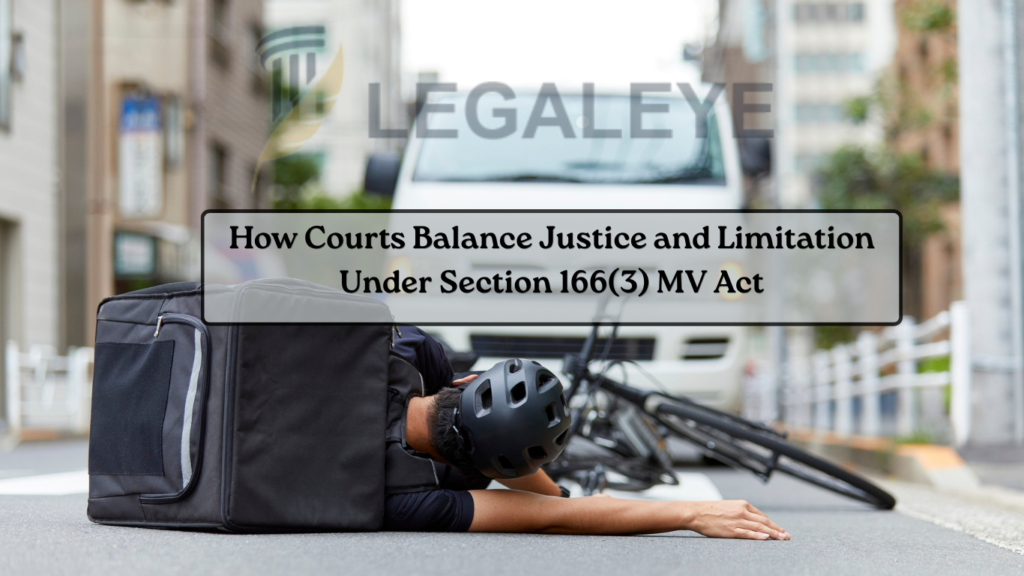
How Courts Balance Justice and Limitation Under Section 166(3) MV Act
Road accidents can cause severe physical, emotional, and financial hardships for victims and their families. To provide relief, the Motor Vehicles Act allows injured persons or the legal representatives of deceased victims to seek compensation before the Motor Accident Claims Tribunal (MACT). One important aspect that has often been discussed by courts is the issue of limitation and delayed filing of claims under Section 166(3) of the Motor Vehicles Act. Over the years, courts, including the Supreme Court, have emphasized that procedural rules should not defeat the cause of justice, especially in accident compensation matters.
Understanding Section 166(3) of the MV Act
Section 166 of the Motor Vehicles Act deals with applications for compensation arising from motor vehicle accidents. Earlier, Section 166(3) prescribed a limitation period within which claim petitions had to be filed. However, considering the welfare nature of the legislation and the difficulties faced by accident victims, the limitation provision was later omitted.
The legislative intent behind this change was to ensure that genuine claimants are not denied compensation merely because of delays in approaching the tribunal. Courts have consistently recognized that victims may face medical emergencies, financial difficulties, or lack of legal awareness, which can prevent them from filing claims within a specific timeframe.
The Principle of Justice Over Technicalities
The Supreme Court has repeatedly held that the Motor Vehicles Act is a beneficial piece of legislation aimed at providing relief to accident victims. Therefore, tribunals and courts should adopt a liberal approach while dealing with compensation claims.
In several judgments, the Court observed that technical objections relating to limitation should not overshadow the primary objective of ensuring justice. Compensation is meant to alleviate the suffering of victims and their families, and denying relief solely on procedural grounds may lead to grave injustice.
This approach reflects the broader legal principle that substantive justice should prevail over procedural technicalities whenever possible.
Why Delays Occur in Motor Accident Cases
There are various reasons why claimants may fail to file petitions immediately after an accident:
- Prolonged medical treatment and hospitalization.
- Financial distress following the accident.
- Lack of awareness about legal rights.
- Emotional trauma and psychological stress.
- Delays in obtaining necessary documents such as FIRs, medical records, and post-mortem reports.
- Rural or remote location challenges.
Recognizing these realities, courts often evaluate the circumstances surrounding the delay rather than rejecting claims outright.
Balancing Limitation and Fairness
While courts are sympathetic toward accident victims, they also consider the importance of legal certainty and fairness. Excessive delays can sometimes create difficulties in verifying evidence, examining witnesses, and determining liability.
Therefore, courts attempt to strike a balance between two competing interests:
- Protecting the rights of accident victims.
- Ensuring fairness to insurance companies and other respondents.
When deciding delayed claims, tribunals examine whether the delay was reasonable and whether the claimant has acted in good faith. The overall objective remains the delivery of justice rather than strict adherence to procedural requirements.
Impact on Motor Accident Compensation Claims
The judicial approach toward limitation has significantly strengthened the rights of accident victims. By focusing on fairness and equity, courts have ensured that deserving claimants receive compensation despite delays in filing applications.
This approach has encouraged tribunals to examine the merits of each Motor Accident Claim rather than dismissing cases solely on technical grounds. As a result, many victims who would otherwise have been denied relief have been able to secure compensation for medical expenses, loss of income, disability, and other damages.
The welfare-oriented interpretation adopted by courts reflects the social purpose of the Motor Vehicles Act and promotes access to justice for all.
Role of the Motor Accident Claims Tribunal
The Motor Accident Claims Tribunal plays a crucial role in assessing compensation claims. Tribunals are expected to act fairly, efficiently, and with sensitivity toward the challenges faced by accident victims.
While evaluating delayed petitions, tribunals consider:
- The reasons for the delay.
- The availability of supporting evidence.
- The genuineness of the claim.
- The conduct of the parties involved.
- The overall interests of justice.
By adopting a balanced approach, tribunals ensure that deserving claimants are not deprived of compensation due to procedural hurdles.
Conclusion
The evolution of judicial interpretation under Section 166(3) of the Motor Vehicles Act demonstrates the commitment of Indian courts to ensuring substantive justice. The Supreme Court has consistently emphasized that compensation laws are welfare-oriented and should be interpreted in a manner that benefits accident victims.
Although timely filing remains desirable, courts recognize that genuine claimants may face circumstances beyond their control. Consequently, the focus remains on determining the merits of a Motor Accident Claim rather than rigidly applying technical limitations.
For individuals seeking legal assistance in motor accident compensation matters, professional guidance can be invaluable. Advocate P.S. Khurana, a legal professional with experience in accident compensation and civil litigation matters, advises claimants to act promptly while ensuring that their legal rights are effectively protected.