
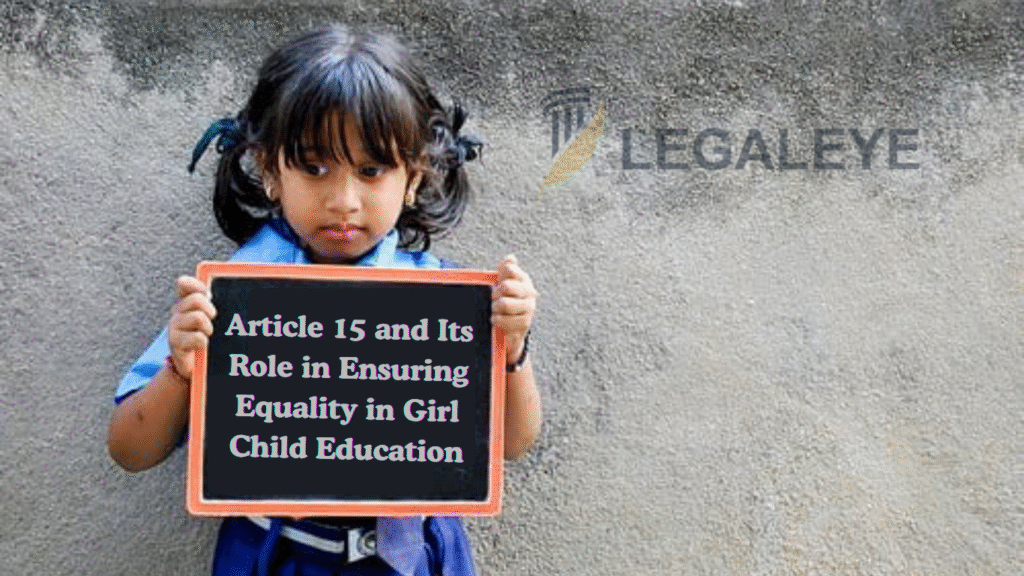
Article 15 and Its Role in Ensuring Equality in Girl Child Education – Education is one of the most powerful tools to bring about social transformation and gender equality. However, for centuries, girls in India faced barriers to accessing education due to deep-rooted patriarchal norms, economic challenges, and cultural prejudices. Recognizing this inequality, the framers of the Indian Constitution embedded several provisions to ensure that every child, irrespective of gender, enjoys equal educational opportunities. Among these, Article 15 plays a critical role in promoting equality and ensuring the empowerment of the girl child through education — forming a cornerstone of India’s Constitutional Law framework.
Understanding Article 15 and Its Relevance
Article 15 of the Indian Constitution prohibits discrimination by the State against any citizen on grounds of religion, race, caste, sex, or place of birth. Specifically, Article 15(1) and 15(2) ensure that no citizen is denied access to public places, educational institutions, or welfare programs due to these factors. This clause directly safeguards the right of girls to access educational institutions on an equal footing with boys.
Moreover, Article 15(3) empowers the State to make special provisions for women and children. This clause is especially significant as it allows for positive discrimination — meaning that the State can introduce specific schemes, reservations, or benefits aimed at promoting girl child education. Thus, instead of merely prohibiting discrimination, Article 15 goes a step further by encouraging proactive measures to bridge gender gaps in education.
As noted by legal expert Advocate P.S. Khurana, Article 15 serves as a dual mechanism — it prevents gender-based exclusion while simultaneously authorizing targeted efforts to uplift marginalized sections, including young girls deprived of learning opportunities. This constitutional vision reflects India’s commitment to both equality and equity in education.
Implementation of Article 15 in Girl Child Education
The practical impact of Article 15 can be seen in the various educational schemes and laws formulated by the government. For instance, the Right to Education Act (RTE), 2009, operationalizes Article 21-A (Right to Education) while being deeply rooted in the non-discrimination principle of Article 15. It mandates free and compulsory education for all children between the ages of 6 and 14, thereby ensuring that every girl has the constitutional right to study.
Furthermore, numerous government initiatives are directly inspired by the constitutional protection provided under Article 15(3). Programs such as Beti Bachao Beti Padhao, Kasturba Gandhi Balika Vidyalaya, and National Scheme of Incentives to Girls for Secondary Education aim to increase enrollment and reduce dropout rates among girls. These efforts reflect how the State uses its power under Article 15 to prioritize the education of the girl child and promote gender equality.
Judicial Interpretation and Support
Over the years, Indian courts have played a vital role in interpreting Constitutional Law provisions like Article 15 to strengthen the right to education for girls. In several judgments, the judiciary has emphasized that gender-based discrimination in education violates the core principles of equality and justice.
For instance, the Supreme Court has repeatedly highlighted that equality is not merely a legal formality but a social necessity for development. In cases related to access to schools, scholarships, and educational resources, courts have reaffirmed that policies favoring women and girls are constitutionally valid under Article 15(3). These interpretations have helped ensure that the right to education for girls is not just theoretical but enforceable.
Socio-Legal Impact of Article 15
Article 15 has contributed significantly to improving literacy and education rates among girls across India. The increase in female literacy from 8.9% in 1951 to over 70% today stands as evidence of how constitutional protections, when combined with active policymaking, can create real change.
Beyond access, Article 15 has also promoted the idea of equality within education — ensuring that girls receive the same quality of instruction, infrastructure, and opportunities as boys. It has empowered generations of women to enter professions, contribute to the economy, and challenge societal stereotypes.
The Road Ahead
Despite substantial progress, challenges such as poverty, social stigma, and rural-urban disparities continue to limit the full realization of constitutional goals. To overcome these, India must strengthen awareness of constitutional rights, invest in rural education infrastructure, and enforce gender-sensitive policies at the ground level.
Article 15 remains a living document — a constitutional promise that must be renewed through collective effort, social awareness, and legal commitment. Ensuring that every girl in India can access education without discrimination is not only a constitutional mandate but a moral obligation that defines our democracy’s maturity.
In conclusion, Article 15 acts as both a shield and a sword in the fight for gender equality in education. It shields girls from discrimination while empowering the State to take affirmative steps toward their upliftment. By embracing the spirit of Constitutional Law, India continues its journey toward creating an equitable educational landscape where every girl can learn, grow, and lead with dignity — fulfilling the true vision of the Constitution’s framers.