
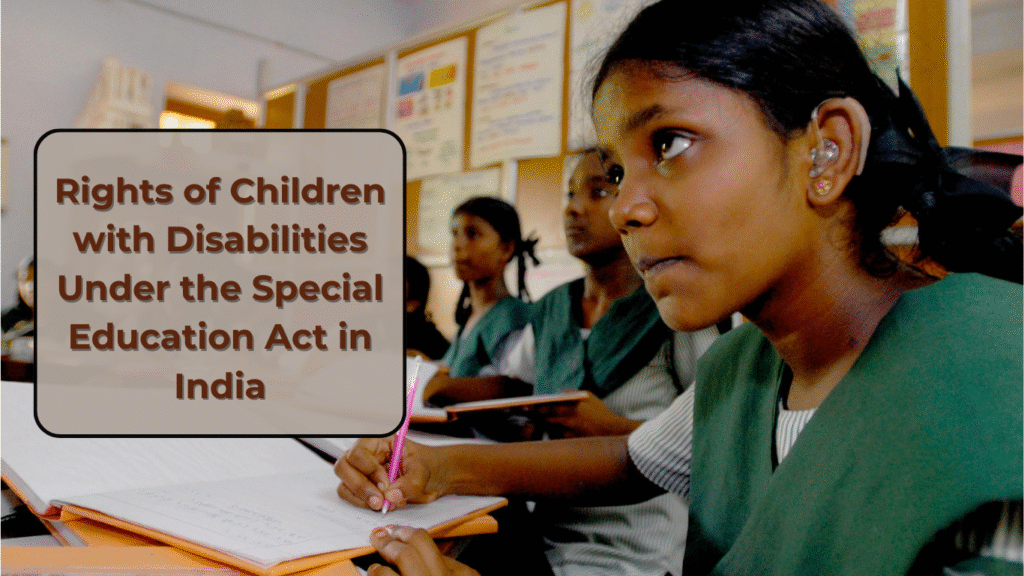
Rights of Children with Disabilities Under the Special Education Act in India
India’s commitment to safeguarding the educational rights of children with disabilities has grown significantly in recent years. Central to this effort is the Special Education Act in India, which works in tandem with several education laws to ensure inclusive, equitable, and quality education for all children—regardless of their physical or intellectual abilities.
Understanding the Legal Framework
While there is no standalone statute called the “Special Education Act,” India has enacted several robust legal provisions for inclusive education. The key legislation includes:
-
The Rights of Persons with Disabilities Act (RPWD), 2016
-
The Right to Education Act (RTE), 2009
-
The Rehabilitation Council of India Act, 1992
-
National Education Policy (NEP), 2020
Collectively, these laws are often referred to under the umbrella term Special Education Act in India by practitioners and educators.
Key Rights Guaranteed Under the Act
1. Right to Free and Inclusive Education
Under the Right to Education Act, 2009, every child aged 6 to 14 years has the right to free and compulsory education. The RPWD Act strengthens this by ensuring that children with benchmark disabilities have access to inclusive education in mainstream schools.
Inclusive education means that schools must provide the necessary infrastructure, assistive devices, and trained educators to accommodate all learners. This aligns with global standards set by the UN Convention on the Rights of Persons with Disabilities (UNCRPD), which India ratified.
2. Right to Reasonable Accommodation
Children with disabilities are entitled to reasonable accommodation in schools. This includes modifications to the curriculum, teaching methods, and examination patterns. For instance, visually impaired students may receive question papers in Braille or have the assistance of scribes during exams.
3. Right to Non-Discrimination
The special education act in India explicitly prohibits discrimination on the basis of disability. Any form of denial of admission, unjustified expulsion, or bullying of disabled students is punishable under the RPWD Act. Schools are mandated to ensure a safe and nurturing environment for children with special needs.
4. Right to Special Educators and Support Staff
Schools must employ special educators trained in handling children with learning disabilities, autism, cerebral palsy, and other cognitive or developmental disorders. The Rehabilitation Council of India (RCI) certifies these professionals. The law also requires support services such as therapists, counselors, and inclusive education resource centers.
5. Right to Transportation and Accessibility
The RPWD Act mandates that educational institutions must be physically accessible. This includes ramps, tactile paths, elevators, and adapted toilets. Transportation facilities must also be provided or subsidized to ensure that no child is denied education due to mobility issues.
6. Right to Early Identification and Intervention
Children with developmental delays or disabilities must be identified at an early age and provided with therapeutic, educational, and social support. The RPWD Act and various education laws direct state governments to implement screening and early intervention programs at the community level.
Challenges in Implementation
While the special education act in India provides a solid legal foundation, its implementation remains inconsistent. Rural areas often lack trained educators and accessible infrastructure. Budgetary constraints and social stigma further hamper the effectiveness of these laws.
Advocate P.S. Khurana, a seasoned legal expert in education and disability rights, points out:
“The gap between policy and practice needs urgent attention. Effective implementation of inclusive education policies requires coordination between schools, government bodies, and civil society.”
The Way Forward
To truly realize the vision of inclusive education, the following measures are essential:
-
Greater investment in special educator training programs
-
Periodic audits of school infrastructure for accessibility
-
Community awareness campaigns to combat stigma
-
Legal awareness initiatives for parents of children with disabilities
Conclusion
The special education act and associated education laws in India offer a comprehensive framework to protect the rights of children with disabilities. However, achieving the goal of true inclusivity requires collective responsibility. By embracing the principles of dignity, equality, and support, we can ensure that every child—regardless of ability—receives the education they deserve.